Group seeks to further reconciliation with Indigenous peoples
Canadian Catholic News
A coalition of seven Catholic organizations has launched the Our Lady of Guadalupe Circle in an effort to promote further reconciliation efforts with Canada’s Indigenous peoples.
“Every religion, besides Catholics, had their own national response to reconciliation with Indigenous people,” says Deacon Rennie Nahanee, chair of the Canadian Catholic Aboriginal Council (CCAC). He is one of five Indigenous members of the newly formed Circle and coordinator of First Nations ministry for the Archdiocese of Vancouver.
“We want to work with Indigenous communities on an equal level through dialogue so they can know about the Church and what it does on the reserves, and the Church can learn the customs and cultures of the Indigenous in return,” Deacon Nahanee said.
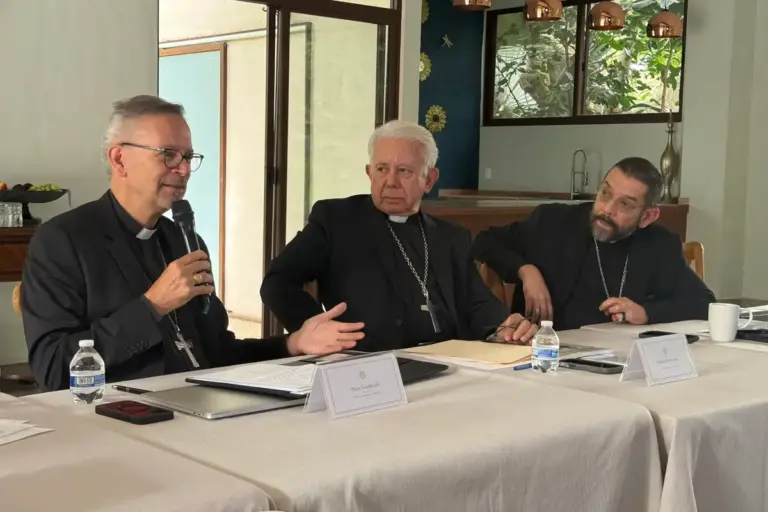
Members formally inaugurated the Circle Dec. 5 at the Canadian Conference of Catholic Bishops (CCCB) offices in Ottawa and will be meeting again Jan. 26 in Ottawa.
Along with the aboriginal council and the Canadian bishops, members of the Circle include the Canadian Religious Conference, the Canadian Catholic Organization for Development and Peace (CCODP), the Knights of Columbus, the Saint Vincent de Paul Society, and the Catholic Women’s League.
“I’m looking forward to a happy new year in 2017 for Indigenous people and the Catholic Church,” Deacon Nahanee said. “Between the Church and Indigenous peoples, not everybody knows what their roles are and these need to be defined in the new year,” he said.
“It shows we are taking seriously the response to the TRC Calls to Action,” he added. “We want to want to have a good relationship with Indigenous people like we used to prior to the residential schools.”
Each side needs to respect the other, and the Church is changing, he said. “They want to listen to what the Indigenous peoples are saying. Indigenous people need to understand how the Church operates and works and has been doing for a long time.
“It’s just now we’re on an equal basis,” he said. “No more residential school telling you what you should do, but what we can do together.”
The Truth and Reconciliation Commission has laid out a roadmap for that work, he said. “We cannot respond to everything they are asking for, but we can do what we can do. I believe it’s going to be great.”
Members of the Circle were already “talking and exchanging in an informal way” as part of a working group, said Josianne Gauthier, director of InCanada programs for CCODP. The group was working on defining a mandate to “give ourselves some objectives as Catholic movements going forward.”
The groups had crafted a joint submission to the TRC’s Calls to Action from the churches involved in running Indian residential schools.
“The idea was to have a national response, because we are not a national church like the Anglican Church,” said Deacon Nahanee. “We wanted to have groups that were more or less representative of a national Catholic response.”
Membership in the Circle means “embracing our responsibilities” and examining the “impact of reconciliation on the future of our mission,” Gauthier said. The Circle will examine how reconciliation is “lived out and how it connects to our mission for social justice, peace, and the rights of all . . .”
The Circle’s mission statement reads, “Our Lady of Guadalupe Circle is a Catholic coalition of Indigenous people, bishops, clergy, lay movements and institutes of consecrated life, engaged in renewing and fostering relationships between the Catholic Church and Indigenous people in Canada.”