Prelate was the keynote speaker at the Bishop’s Name Day Tea
The B.C. Catholic
The Catholic faith in Ukraine has survived many decades of persecution. Ukrainian Bishop Borys Gudziak ventured to the Eparchy of Edmonton to share some of that history, and his personal history, with Edmontonians.
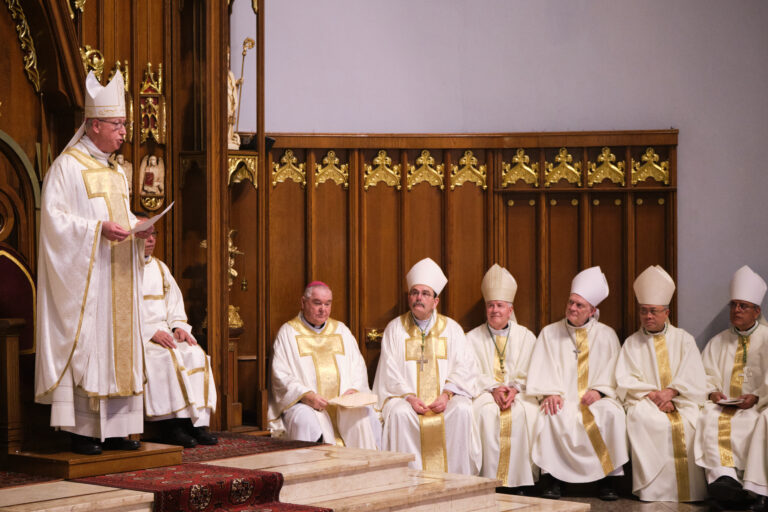
Bishop Gudziak of the Ukrainian Catholic Eparchy of Saint Vladimir the Great of Paris (which covers France, the Benelux countries, and Switzerland), spoke to 200 people in Edmonton on Oct. 16 about the history of the Ukrainian Catholic faith, his experiences evangelizing, and helping to re-establish the Ukrainian Catholic University (UCU). He is also the president of UCU.
“In 1900 there were three eparchies and three bishops for the Ukrainian Catholic Church,” said Bishop Gudziak. “One hundred and sixteen years later, after a century of persecution and being refugees, Ukrainian Catholics now have 33 eparchies, 51 bishops, and 3,000 priests.”
He was the keynote speaker at an event called the Bishop’s Name Day Tea celebrating the Ukrainian tradition of “honouring a person on the feast day of the saint whose name that person was given,” explained Jayne Buryn, the communications coordinator of the Eparchy of Edmonton. This year the event honoured Eparch David Motiuk of Edmonton.
Members of several Ukrainian Catholic organizations, including the Ukrainian Catholic Youth, Catholic Brotherhood, and the Knights of Columbus, attended the event, sponsored by the Ukrainian CWL, to celebrate Bishop Motiuk and listen to Bishop Gudziak’s experience.
Persecuted by the Soviet Union, Ukrainian Catholics earned “the gold medal of human enterprise, for there is nothing greater than standing up to totalitarianism,” said Bishop Gudziak. Many martyred Ukrainians remain nameless, but their actions were perfect examples of true faith.
Bishop Gudziak was inspired by the actions of the Ukrainian Catholics, many who were illiterate during the reign of the Soviet Union. “Who could believe that the Soviet Union would fall apart, that Ukraine would rise as it did?” he asked.
“They discovered that nobody gets in your way when they don’t take you seriously. Today Ukraine is showing us that what is impossible for us is possible for the Lord.”
The bishop, once an American student, applied for a U.S.A.-U.S.S.R. exchange and moved to Ukraine, which was still under Soviet control in 1988. In the early 1990s, Bishop Gudziak organized a “Youth for Christ” rally, the first UGCC youth rally in Ukraine since 1933. More than 40,000 attended.
After returning to the U.S. to be ordained a priest in 1988, Bishop Gudziak returned to Lviv in western Ukraine, where he helped re-establish the Ukrainian Catholic University.
“Hundreds of priests, lay people in business and politics, who have graduated from UCU, are transforming a society… a country that is struggling against a war, poverty, and corruption,” Bishop Budziak said.
“Since its inception, hundreds of young women have graduated with doctorates as theologians, and as teachers themselves, leading the way,” said Buryn. The university was built on “two pillars: martyrs and the marginalized,” seeking to grant all a chance to education, regardless of mental and physical disabilities.
Since then, Bishop Gudziak has been appointed Bishop of Paris and the Benelux countries. Initially worried of the challenge the city of Paris provided with its 8 million population and only a small community of Ukrainian Catholics, he asked himself, “What chance did the apostle Peter have in the alpha city of Rome, with its population of 2 million and a vast variety of beliefs?”
“Maybe we Ukrainian Catholics are called to make a difference in Paris,” Bishop Gudziak thought at the time. “We really need priests and sisters in this eparchy and from this eparchy” to continue building the Church for Christ.