Sayegh family’s home was bombed three times before they fled and sought peace in Canada
The B.C. Catholic
RICHMOND
When Albert Sayegh fled Syria, he brought a piece of the war with him. A shred of shrapnel is embedded in his flesh on his left side.
“My flat was attacked three times,” Sayegh told The B.C. Catholic from his Richmond apartment. He fled Syria with his wife and three children in 2014, a few months before the war’s four-year mark, and landed here this spring.
“Before, we didn’t think to leave our country. We had good conditions there. We had a good job, a good flat, and a car. We tried to stay until the war finished, but the war was too long.”
Sayegh, a mechanical engineer, had a successful career that sent him on business trips around the world. While visiting China, he discovered a good wooden furniture supplier, shipped some pieces home, and opened a small shop. Less than one year later, the enemy moved in to his Aleppo neighbourhood.
“The terrorists entered our city suddenly. In one day, two days, they made a circle. My furniture store was on their side, so they took everything: about $40,000 U.S. gone.”
Aleppo and the surrounding area became a “big jail.” The only gap in the rebel wall, which they opened and closed at will, was south of Aleppo in the direction of the capital, Damascus.
Sayegh said this siege lasted for about a year. When the city was surrounded, prices for food and other items soared. “Maybe we can get two or three tomatoes per 10 days. Cucumber? It’s like a dream when you get a cucumber.”
Within sniper range
The Sayegh family lived less than one kilometre from the enemy; a small number of apartment buildings stood between their home and a wooded area claimed by rebels.
Living within sniper range, “We cannot go on our balcony. Very dangerous,” he said.
“When we go out, he can kill us anytime if he wants, so we walk beside the wall. If we run or do something wrong, he can kill.”
He and his wife, Nahla, would not leave home unless they had to. “When we (were) going to enter a building, I tell her: you go first. I will follow, because if he is going to kill us, he’s not going to kill two parents together. One of us must stay alive.”
Then there were bombs. “Every week, two or three times, sending a gift: a bomb. It was sometimes 200 metres away, sometimes here, sometimes on the top of the building.”
Three times, blasts shook their home.
Scarred by attacks
The first bomb that hit the street outside their home blew out windows and damaged the balcony. When the dust cleared, Sayegh set out to fix them.
Two weeks later, he had almost finished the repairs. On a Sunday morning in November, with at least an hour to go before Mass, he picked up his tools. He was working slowly in the 9 a.m. sunshine with a small, dark coffee beside him.
“Suddenly, I remember well, I saw light,” Sayegh said. A bomb struck the street again, sending out incredible noise, blinding light, and clouds of smoke. Sayegh could not see more than 10 metres in front of him.
A piece of shrapnel shot into his left side, piercing flesh but missing organs. When the shock gave way to pain, Sayegh loosened his pants and saw blood begin to flow.
He didn’t rush to the hospital. “Usually they send one, two, three bombs. They send first one. The people will come to see what happened. They send a second one to kill more people.”
After 45 minutes, his brother-in-law, who lived on the first floor, took him to the hospital. Doctors took an x-ray and ultrasound, confirmed that the shrapnel didn’t pose a serious threat to his organs, and him gave some medicine.
“When I see other people, one guy leg cut, one guy without an ear, I feel shy. No need to ask the doctor more,” he said. “Thanks God nothing more happened. It may have come in my head or my heart.”
Scarred by the attack, he planned to repair his apartment yet again. Three days later, a bomb hit the street outside his home 20 minutes after his family had been walking on it.
They “would have been killed if they were minutes late. After that, we decided to leave: no more to wait.”
Escaping to safety
The family became refugees on Christmas Day in 2014.
They decided to drive to Damascus, then cross to Jordan. The drive to Damascus, usually about 3 and a half hours, lasted 13 hours on a route plagued with closed roads and security checkpoints. His sister’s family, who lived in the same apartment building, stayed behind.
They landed in Jordan and lived there for 14 months, waiting for approval to come to Canada. Thanks to Canadian Martyrs Parish, they landed at Vancouver airport Feb. 23.
“Everything is good,” said their teen daughter Lydia, sitting near her younger brothers Jack and Emile. “It’s a new city, and everything is beautiful here.”
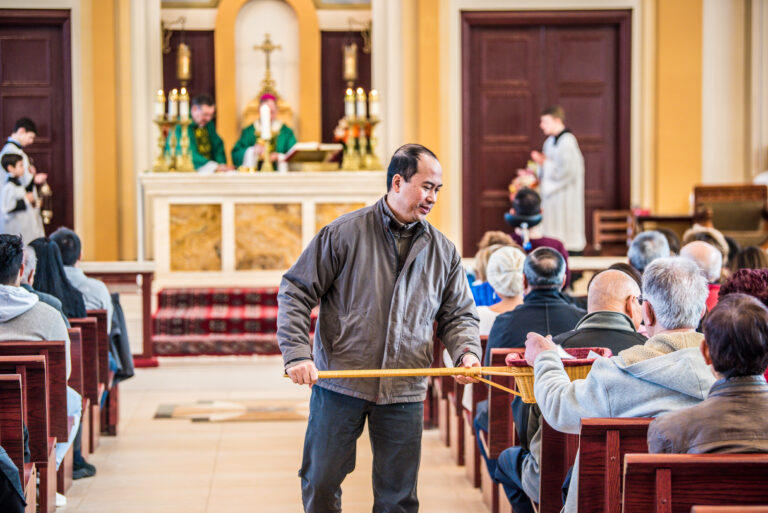
Father Richard Au, pastor of Canadian Martyrs, heard about the family thanks to friendly ties with the bishop of Jerusalem.
“The Catholic churches in the Holy Land, in the Latin Patriarchy, are very generous in doing what they can for refugees, whether they be in Lebanon or Jordan.”
His parishioners came together to help the family, finding them a home, donating furniture, and hosting fundraisers. One event, held on Chinese New Year, even featured Archbishop J. Michael Miller, CSB, performing a song on stage.
“What I have seen is that generosity continues to pour out from this parish,” Father Au said. “This is a great achievement, caring for those whom we do not even know and supporting our vulnerable brothers and sisters who know only suffering.”
The priest continues to connect refugee families with local parishes who can sponsor them.
“Canada, from the first week, is looking very nice,” Sayegh said.