Bill C-16 adds gender identity and gender expression to the list of prohibited grounds of discrimination
OTTAWA (CCN)
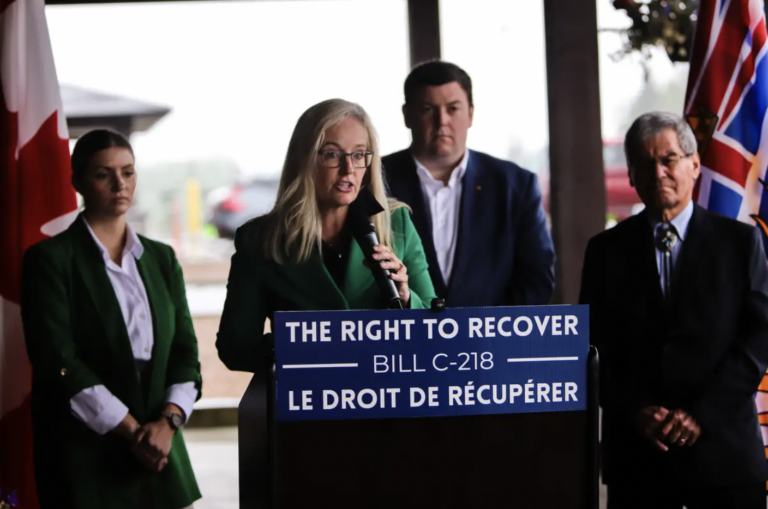
Attorney General Jody Wilson-Raybould introduced Transgender Bill C-16 in the House of Commons May 17, flanked by dozens of members and advocates.
Bill C-16 adds gender identity and gender expression to the list of prohibited grounds of discrimination such as sex, religion, disability, and race in the Canadian Human Rights Act. It would add “gender identity or expression” to the list of identifiable groups for hate propaganda and hate speech purposes in the criminal code.
“In Canada, we celebrate inclusion and diversity,” said Wilson-Raybould. “All Canadians should be safe to be themselves.”
“The law should be clear and explicit: transgender and other gender-diverse persons have a right to live free from discrimination, hate propaganda, and hate crime,” she said.
Among the trans advocates was Charlie Lowthian-Rickert, 12, who identifies as a girl. Lowthian-Rickert thanked the government for introducing this bill, “I feel much safer,” she said.
The news conference ended before the Attorney General could face questions concerning the use of women’s and girls’ washrooms and locker-rooms, or eligibility to play on sports teams of the gender with which one identifies.
In the United States, President Obama recently issued an edict that all publicly funded schools must allow those who identify as a gender different from their biological sex to use the bathroom or locker room or other school facility corresponding to the gender they choose.
“The prime minister has been drinking too much Kool-Aid with the president of the United States,” said Conservative MP and Justice Committee co-chair Ted Falk. He noted Justin Trudeau has made two visits to the United States since his election, one for a state dinner, and another for a conference.
“For them to come out almost simultaneously with the same agenda,” he said. “It’s very disheartening. It will be an assault on morality and on families.”
“I think people will be in uproar about it,” he said. “I hope people will get engaged and say this is too much.”
“We’re talking about the morality of a country and its citizens, what has been for decades accepted as normal and moral is now being challenged,” he said. “I think the traditional family is actually being bullied on this.
Falk said people are being asked to “give up ground” in their personal rights and freedoms to use a bathroom consistent with their sex, and not have to share it with someone of the opposite sex who thinks they have the opposite sex gender. “I don’t think that’s appropriate.”
For McGill University Professor of Christian Thought Douglas Farrow, the agenda behind legislation such as Bill C-16 goes far beyond expectations of privacy in bathroom or locker room use.
“Such bills, whatever the ignorant suppose, are not about justice and not about compassion,” he said in an email. “They are about detaching the law from the truth of the body. Nor are they merely local or national.”
“They belong to an international effort to change the way we regard the body,” he said. “Their consequences are severe, both for the people caught up in state-sponsored abuse of their bodies and for society at large.”
“The latter has to cope with conflicts between natural rights and freedoms and the artificial rights created by these bills,” he said. “Those members of society, whether in law, medicine, education, business, politics, or religion, who refuse to knuckle under will now find themselves the objects, not only of vilification, but also of legal action.”
“By introducing this bill, the Liberal Government is introducing civic strife for which there is no obvious resolution and from which there is no obvious exit,” he said. “In short, it is doubling down on its euthanasia decision. The combined effect of such moves will be to destroy the existing, rather tenuous, social contract.”
Because gender identity is not an objective criterion such as race, or disability, “it becomes difficult to determine whether different treatment was based on that criterion,” said Constitutional Lawyer Albertos Polizogopoulos. Gender identity is about how a person feels, and someone else “may not know what that person’s gender identity is. It becomes a ‘he said; she said.'”
Polizogopoulos said he had a client faced with a human rights complaint based on gender identity. “The conduct at issue was not motivated by the gender identity of the complainant.” The complainant “thought it was, and it became impossible to prove otherwise,” he said.
“None of the people I represent think it’s okay to discriminate on the basis of gender identity,” he said. “The concern is how adding this kind of language will affect freedom of conscience and religion. The fear is that it may.”
Moira McQueen, the executive director of the Canadian Catholic Bioethics Institute, pointed out school boards, including Catholic boards, are already coming under some pressure from a small but growing number of children who self-identity as the opposite sex as early as junior and senior kindergarten.
“If the law passes, it will intensify,” she said.
While Catholic teaching is clear that human beings are created male or female, McQueen said, Catholic schools are adopting policies sensitive to children experiencing gender dysphoria and try to accommodate them by allowing them to use the name and clothing or uniform type they choose. This does not, however, extend to using the opposite-sex washroom or locker room, she said.
Such children are offered separate washrooms, so their needs are accommodated, but the schools are “trying to take account of the common good,” she said. “Instead of an emphasis on the individual as the only person who needs to be considered, especially in a community like a school, they have to take into consideration what other students think as well.”