
OTTAWA (CCN)—The Catholic Women’s League is raising concerns about the impact the new transgender law will have on freedom of religion and speech.
In Aug. 16 letters to the Canadian Conference of Catholic Bishops and Prime Minister Justin Trudeau, the CWL’s national president Margaret Ann Jacobs raised concerns about the passage of Bill C-16, that added “gender identity and gender expression” to the Canadian Human Rights Act and to the Criminal Code’s hate speech provisions.
“Members of The Catholic Women’s League of Canada are concerned that the passage of Bill C-16 will not allow Canadian citizens, a proportionately large segment of which are Catholic, to live out their faith and peaceably disagree with the current gender theory without fear of reprisal,” CWL National President Margaret Ann Jacobs wrote in an Aug. 16 letter to Prime Minister Justin Trudeau.
“The League will always stand in support of any and all efforts to support and uphold the dignity of persons, their right to live in peaceful co-existence with others, and the right of all persons to speak their own truth in love.”
The letter reiterated a July 7 statement by the Canadian Conference of Catholic Bishops that called any form of unjust discrimination morally wrong, including against those who identify as transgender.
Jacobs also wrote the CCCB president Bishop Douglas Crosby of Hamilton, thanking the bishops for their statement. On behalf of CWL members, she praised the CCCB for “taking a courageous stand in voicing the concerns of its many faithful regarding their own rights, and indeed the right of the Church, to be able to peaceably disagree with current gender theory without fear of losing the many faithful’s freedom of speech, association or religion.”
Jacobs, in an interview, said the letters resulted from motions passed on the floor of the CWL’s national convention Aug. 6-9 in Charlottetown out of a “deep concern C-16 failed to respect the fundamental rights of freedom of religion and speech.”
The letter to Prime Minister Trudeau also asked for a face-to-face meeting with him, she said.
A related motion urged provincial and territorial councils to support the CCCB statement and to study papal teachings on the central tenets of gender theory, she said.
The national convention adopted four resolutions Canada’s largest women’s group intends to raise with the federal government: mandatory age verification for pornography sites to prevent children from accessing them; conscience rights protection for health-care workers added to the Criminal Code; implementation of the Supreme Court of Canada’s 1999 Gladue decision recognizing mitigating social and historical factors in the sentencing of indigenous offenders; and removal of the GST on mandatory child safety products such as car seats.
Jacobs said the resolution regarding age verification is designed to prevent children accidentally ending up on pornographic websites. Other countries such as the United Kingdom, have introduced age verification mechanisms, she said.
The resolution to protect health care workers from coercion that would violate their consciences came from the B.C. and Yukon Provincial Council because there is concern other provinces might follow Ontario’s lead, Jacobs said. Ontario’s College of Physicians and Surgeons requires doctors to make effective referrals when it comes to euthanasia, abortion or other procedures and in some emergency situations, to perform them.
That resolution urges the federal government to “amend the Criminal Code of Canada to be consistent with the Canadian Charter of Rights and Freedoms by making it an offence to coerce health-care professionals into referring for, or performing procedures that are in opposition to their charter rights of freedom of conscience and religion.”
Many women were “concerned whether they’re going to have the kind of health-care professionals we should have,” said Jacobs. “There are concerns people will choose not to practise medicine if their conscience is going to be violated.”
“A lot of careful study went into the resolutions this year,” Jacobs said. “A lot of lively discussion on the floor. There’s a sense democracy’s at work when people get a chance to voice their opinions.”
Because the CWL is in the process of developing a strategic plan as it approaches its 100th anniversary in 2020, much of the convention’s business was devoted to that, Jacobs said.
The CWL invited sociologist Reginald Bibby, co-author with Angus Reid of Canada’s Catholics: Vitality and Hope in a New Era, to speak at the convention. “If we’re going to plan strategically, we need to know who the Catholics are, for whom we are trying to plan for the future of the League,” Jacobs said.
Bibby’s book gives an overview of how the Catholic Church in Canada is being revitalized by immigration and thus benefiting from a global religious awakening.
Part of the re-visioning, strategic planning process involved a live town hall “that invited women from across the country to connect with the convention site electronically,” Jacobs said.
“My biggest concern was there would be a power outage!” Jacobs said. But the session went well, and people can still respond online for another 30 days.
While the strategic planning is still in its information gathering and consultation process, three themes keep coming up: advocacy, social justice and spirituality – “how we are developing and providing those kinds of things,” Jacobs said.
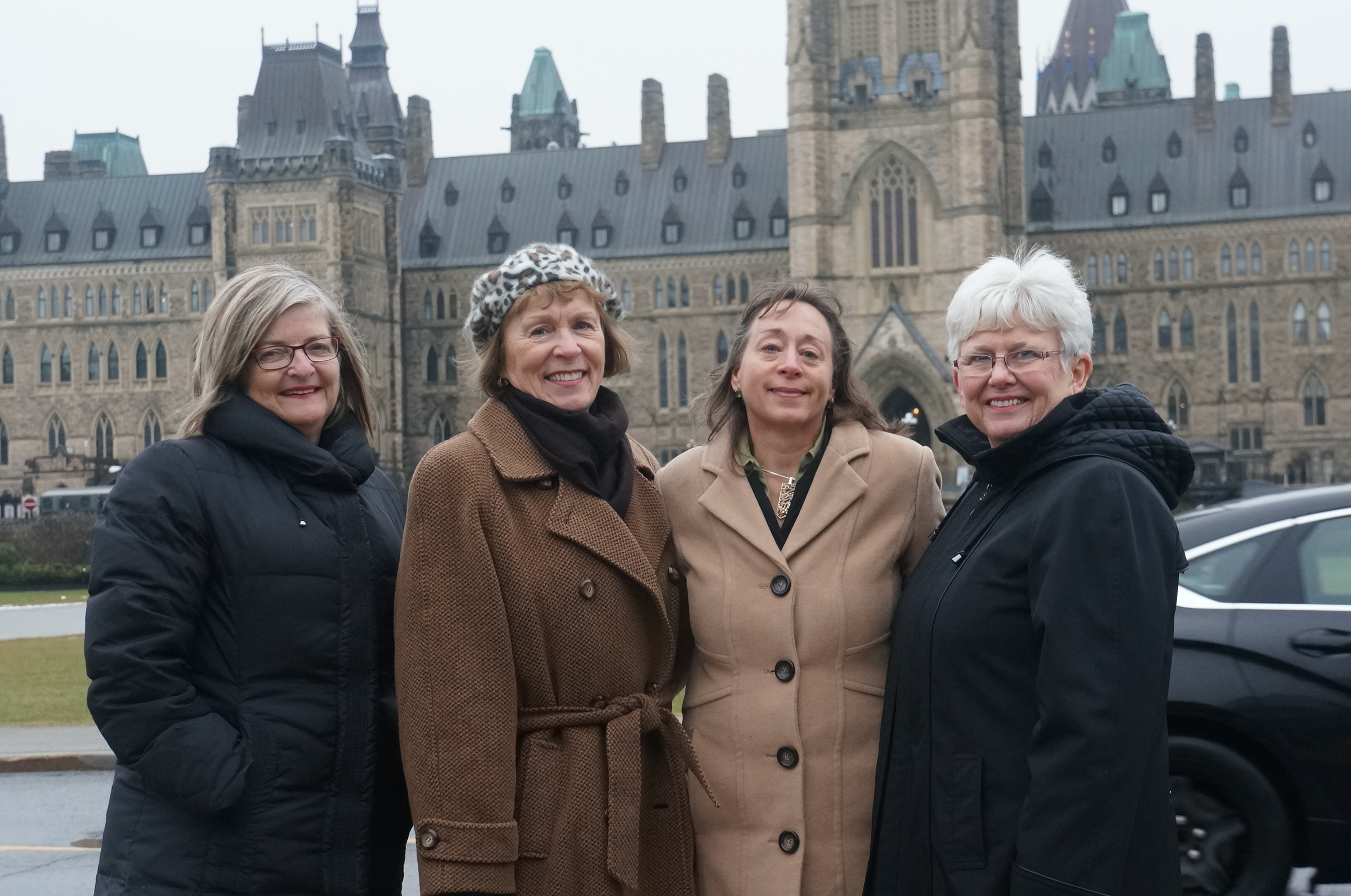
In the fall, the CWL executive will make their annual visit to Parliament Hill to meet with politicians and civil servants regarding the resolutions. This winter, a team will work on putting together a strategic plan to be presented at a pre-convention meeting in August, Jacobs said.
“It’s going to be a challenge to let go of some of the ways in which we have done things in the past, but also exciting to think this is going to be an organization that will be reaching out to members at all levels of the league,” she said.