
NORTH VANCOUVER—The “culture of life” may be better labelled as the “culture of love,” according to American bioethicist and lawyer Wesley J. Smith.
“What has to be defended is that each and every human being has intrinsic dignity that comes from human nature,” Smith told a sold-out crowdat a LifeCanada fundraiser Sept. 8.
“Vulnerable life deserves our extra attention. That runs so contrary to the modern view today. In modern bioethics, unless a bioethicist has a modifier in front of his name like ‘Catholic’ or ‘conservative,’ the view is that vulnerable life actually deserves less protection.”
Smith practised law until 1985, when he picked up a career in public advocacy and published several books on human exceptionalism, euthanasia, and bioethics. He flew to B.C. to speak at LifeCanada’s second annual gala in North Vancouver.
Vulnerable life deserves our extra attention.
Smith argued opponents of the “culture of death” – a phrase Pope John Paul II coined in 1995 to encompass abortion, assisted suicide, and euthanasia – should call themselves a “culture of love.”
“Society used to be about protecting all human life. What is happening in an increasingly secular milieu, in which the sanctity and quality of human life is being rejected,” is the primary purpose of society became “eliminating suffering.”
“Once you accept the premise that the purpose and primary goal of society is eliminating suffering, it quickly morphs into eliminating the sufferer.”
Smith was shocked when he read the Supreme Court of Canada’s decision that decriminalized assisted suicide.
“Even if there are cures, even if there are treatments that can alleviate that suffering, if they would rather be killed, they have that right,” he said.
“A society that believed in the sanctity of human life would say: No. We will care for your suffering. We will mitigate your suffering. We will engage and intervene to help you in your suffering. We will use true compassion, which means to ‘suffer with.’”

He said he would like to see doctors who refuse to assist in
the suicides of their patients hang plaques on their walls saying theirs is
a euthanasia-free zone.
“Every time a doctor says no, they’re sending a powerful message. ‘No, I care enough about you not to kill you. I care for you enough to care for you,’” he said.
“The person who helps the suffering person suffers too. But you have taken some of the suffering and placed it on your own shoulders. That’s what compassion means.”
He added that part of the reason the issue is so divisive is a rejection of human exceptionalism – that human beings have dignity and worth simply because they are human.
“We are the only moral species. We are the only species with duties. We have duties to each other, to our world, to the people who come after us. We have duties to treat animals humanely, to treat the environment properly,” he said.
“It is not intrinsic or inherent in any other species we know of. The seal will never have duties. The squirrel will never have moral obligations.”
Those duties, springing from experience, rationality, and emotion, make homo sapiens unique and treating them as expendable, tragic.
“We owe a greater duty to those who can no longer care for themselves. That is a culture of love.”


Archbishop J. Michael Miller, CSB, agreed that compassion is the key to winning people over when it comes to the life debate.
“What is most convincing to people is often not apologetic arguments,” he said in a short address before dinner and Smith’s keynote presentation. What wins hearts is “witness.”
“This is the kind of witness in ordinary situations we are called to give: to say life, all life, especially vulnerable life … how important it is we treat it with dignity right from conception to its natural end.”
Father Larry Lynn, chaplain for several pro-life initiatives in the Archdiocese of Vancouver, agreed.
“Using reason and love, we can win one person at a time. Only love can infiltrate and change the hearts of those who don’t understand the destructive consequences of the culture of death,” he said.
“The right to life is the first and fundamental right. The more fundamental right is the one which is necessary for the possibility of other rights. If your right to life is taken away, there is no possibility to enjoy the other rights.”
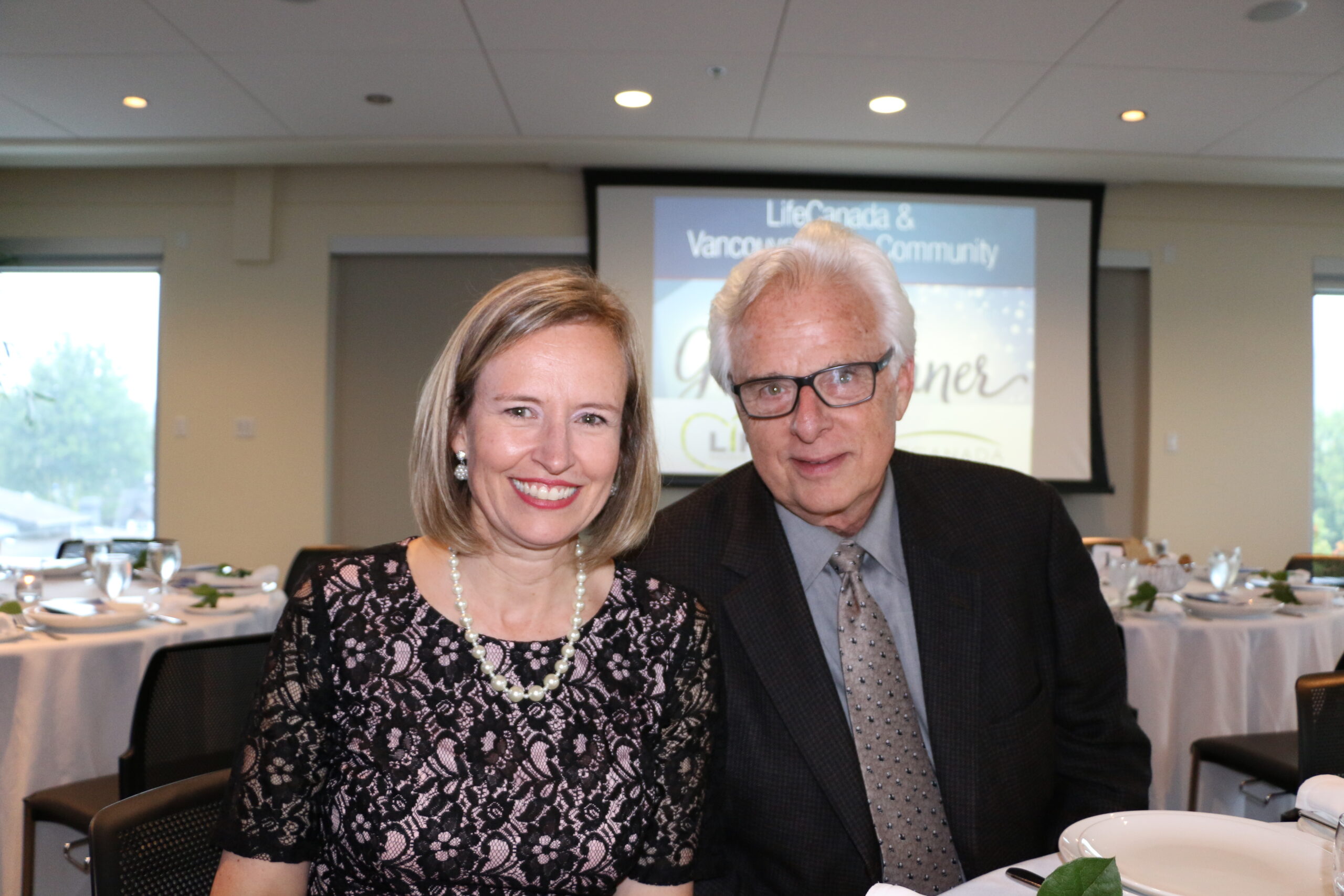
The second annual gala, hosted by LifeCanada in partnership with Vancouver’s Life Community, raised nearly $43,000 for local and national pro-life efforts.