
The assisted suicide death of a Powell River man who struggled for years to find adequate care is a call to Catholics to speak out and “challenge the legitimacy” of bureaucracies that put cost and efficiency ahead of the value of human life, says the Archdiocese of Vancouver’s pro-life chaplain.
Father Larry Lynn said Sean Tagert’s death shows how “the pressure being put on vulnerable people throughout Canada to end their lives for the sake of efficiency is increasing.”
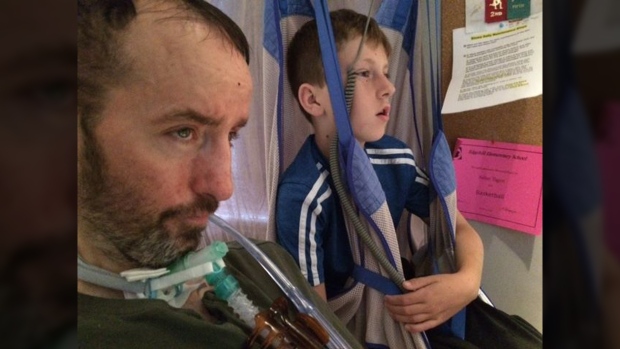
Tagert, 41, was diagnosed with amyotrophic lateral sclerosis, also known as Lou Gehrig’s disease, in March of 2013. In October 2017, he suffered cardiac arrest, and was subsequently placed on a ventilator. His illness robbed him of the ability to move his body, eat, or speak, and he communicated via an eye-gaze computer. His mental acuity was unaffected.
At that time, Tagert’s doctors recommended 24-hour in-home care, which is typical for a person who uses a ventilator full time. Vancouver Coastal Health, Tagert’s regional health authority, only initially offered 15.5 hours of care a day. Eventually, after much effort, they increased their offer to 20 hours a day – which still meant Tagert had to pay $263.50 each day for the remaining four hours of required care.
Tagert and his family continued to fight for coverage of a full day’s care, to no avail.
“Hey everyone. I’ve been quiet lately because I’m just done, worn-out,” wrote Tagert in a July 25 post on his Facebook page.
“So last Friday I officially submitted my Medically assisted death paperwork, with lawyers and doctors, everything in proper order. It’s been over a month since I submitted my appeal to the Vancouver Coastal Health patient care quality department. They didn’t even respond.”
Tagert went on to explain that earlier in the day, two Vancouver Coastal Health officials came to his home, and had refused to talk to him when they realized he was recording the conversation. Eventually, they told his mother that they were there to cut his funding for care hours.
“Welcome to the great Canadian Healthcare system people,” said Tagert.
On Aug. 6, he received a “medically-assisted death” and passed away.
Tagert’s family is urging the government to change the way it treats patients with the disease after he received a “medically-assisted death” following years of struggle to find adequate care.
“We would ask, on Sean’s behalf, that the government recognize the serious problems in its treatment of ALS patients and their families, and find real solutions for those already suffering unimaginably,” reads a post on his Facebook page announcing his passing.
The post outlined the difficulties he endured to remain in his own home.
“Ensuring consistent care was a constant struggle and source of stress for Sean as a patient,” said the post.
“While he succeeded, with the help of many, in piecing together a suitable care facility in his own home (including an expensive saliva-suction machine, needed to prevent him from choking, obtained with the help of donations raised online), gaining the 24-hour care he required was extremely difficult, especially as the provincial government refused to fully fund home care.”
Going to a nursing home was not an option, said the post, as the facilities in his province “would have offered vastly inferior care while separating him from his family, and likely would have hastened his death.” Tagert had partial custody of his 11-year-old son, Aidan.
“Above all else Sean was devoted to his son,” said the post.
“Sean often said that Aidan was his reason for living and had a close relationship with him right to the end.”
Father Lynn told The B.C. Catholic, “There are many things that went wrong in this case but when a secular bureaucracy puts the value of someone’s life at something less than $263.50 per day, we know we had better start challenging the legitimacy of that bureaucracy, that government, that society that tolerates it.”
The incident “speaks directly to the need for individual Catholics to witness to the truth of our faith,” he said.
As the pro-life chaplain he said he has noticed “a slow awakening and a subtle positive change in the pro-life culture in the Lower Mainland. We need to accelerate this awakening…fight this tendency at every turn. We need to pray. Fight and pray.”
John Hof, former president of United for Life B.C., called the incident “outrageous” and said Tagert chose assisted suicide “out of frustration and against his will.”
Hof noted that Fraser Health in 2017 directed that assisted suicide be available in all hospices and care facilities. “Now we have Coastal Health upping the ante by denying appropriate health care to its patients” while allowing him the option of killing himself “to save the system money.”
According to CTV News, Vancouver Coastal Health said its Evergreen House facility in North Vancouver was able to care for fully-ventilated patients with communications equipment like Tagert relied on but said there is a wait list for long-term care.
Tagert documented his email correspondence with VCH as he tried to get into the Evergreen residence. His specific requirements for staying in the facility, including allowing his young son to stay with him, were turned down and he concluded on his Facebook page, “I know I’m asking for change … Hundreds of British Columbians dying horribly every year. The only thing preventing a humane alternative is greed, lies and pathetic excuses … I want people to know the truth about these corporations that (are) literally in charge of our lives … And paid by us.”
Since Tagert’s death, Canadian commentators and palliative care physicians have called for changes in the way the country’s health system handles patients with complicated health needs.
“No one should have to feel death is the only option due to lack of care,” Dr. Leonie Herx, a palliative care physician from Toronto, said on Twitter.
Herx pointed out the paradox that Canadians have a “right” to medically-assisted dying, but not to palliative and disability care.
“We must do better for vulnerable Canadians,” she said.
The ALS Society of Canada was unavailable to comment specifically on Tagert’s case, but CNA was provided with a statement from CEO Tammy Moore saying, “People living with ALS must have access to the appropriate personal care supports and palliative care to meet their needs.”
America patient rights advocate and euthanasia critic Wesley J. Smith commented about Tagert’s case on the Euthanasia Prevention Coalition blog.
With B.C. Catholic files.