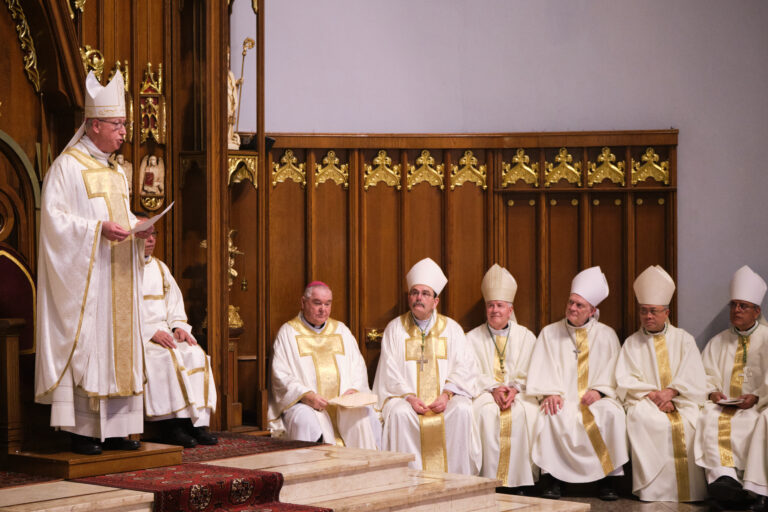
Recognition comes from organization which promotes anti-Catholic ideas
By Deborah Gyapong
OTTAWA (CCN)
Archbishop Paul-Andre Durocher of Gatineau said he accepted an award from FutureChurch to build bridges, not because he agrees with all this controversial group’s stands.
Archbishop Durocher, the past president of the Canadian Conference of Catholic Bishops, said he had been questioned about receiving an award from an organization that promotes the ordination of women to the priesthood, promotion of women to leadership at all levels of the Catholic Church, and married priests, including priests who left the Catholic priesthood to marry.
In a speech delivered via the Internet to FutureChurch’s awards ceremony Sept. 22, Archbishop Durocher said he was approached by people who had asked him if he knew “who FutureChurch is.”
“They have pointed to a number of positions you have taken or initiatives you have undertaken that run counter to the Church’s teaching, particularly on the issue of the access of women to the priesthood,” he said. “I honestly replied that I don’t know your organization very well, and that I would not agree with everything they told me you are about.”
“Nevertheless, like Pope Francis, I believe in building bridges,” he said. “I believe in dialogue. I might not agree with everything you espouse, and you might not agree with everything I do, yet it is important that in the Church we never stop reaching out to each other and working together for the greater good whenever we can.”
FutureChurch gave the award to Archbishop Durocher for suggesting the Church reexamine whether to ordain women to the permanent diaconate during his three-minute address to last year’s synod on the family in Rome. Since then, Pope Francis has set up a commission to study the issue.
In his speech, posted on his blog http://singandwalk.blogspot.com, the archbishop said he was disappointed the main point of his synod intervention—which dealt with violence against women and their “ongoing victimization” even within marriages–had been ignored.
In order to make the Church’s concern credible regarding violence, he had suggested listening to women’s voices in Scriptural reflection and in governance, including “studying the possibility of ordaining women to the permanent diaconate.”
“I believe we can do this without touching on the doctrinal issue of access to the priesthood, which in my opinion is another question,” he told FutureChurch. “The media pounced on the last sentence of my three-minute intervention and basically ignored the rest. And I have to admit I feel some sadness because of this.”
Some have argued ordaining women to the diaconate leads to a slippery slope to ordaining women to the priesthood. Archbishop Durocher disagrees.
“The same argument was made about ordaining married men to the diaconate fifty years ago: it would lead to married priests,” the archbishop said in an email interview. “This has not happened. And if we ever have married priests as a rule in the Roman Catholic (as opposed to Eastern Catholic) Churches, it will not be because we happen to have married deacons.”
William Tighe, a professor of history at Muhlenberg College in Allentown, Pennsylvania, an expert on the Reformation and close observer of the Anglican Communion believes the ordination of women to the diaconate in various parts of the Anglican Communion “without a doubt” led to the ordination of women to the priesthood, and eventually to the episcopate in many of its constituent churches, though at different times.
The Anglican Church of Canada made the change in 1969; the Episcopal Church of the United States in 1976; and the Church of England did so in 1992. Now all three jurisdictions have women bishops.
Professor Tighe said the move to ordain women as deacons in the Church of England would not have passed if the then Bishop of London Graham Leonard had not “come out strongly in favor of the measure, insisting that ‘women deacons’ and ‘women priests’ were two entirely separate matters, and there were ‘women deacons’ in the Early Church.” Bishop Leonard also hoped women would be satisfied with the move, Tighe said. After he became a Catholic, he confided he had been ‘na‹ve’ and ‘misled.”
But most proponents of women’s ordination to the diaconate were aiming for women’s ordination, Tighe said He noted many in the Anglican Communion’s evangelical wing did not have a problem with women’s ordination..
Tighe does not see the Catholic Church following the Anglican Communion’s direction.
“I believe that the ordination of woman to ‘the diaconate’ is not only a bad idea, but an impossibility, in the same way that ordaining women to the priesthood or the episcopate is an impossibility,” said Tighe. “It would be to overturn the Church’s ‘apostolic ministry’ and to attempt to substitute for it a purely human construction.”
“Arguments in favor of it, insofar as they have any reasoned basis at all, rest on a false and fanciful view of ‘the Early Church’ and what ‘deaconesses’ actually were — and whatever they were, they were not ‘woman deacons,'” he said.