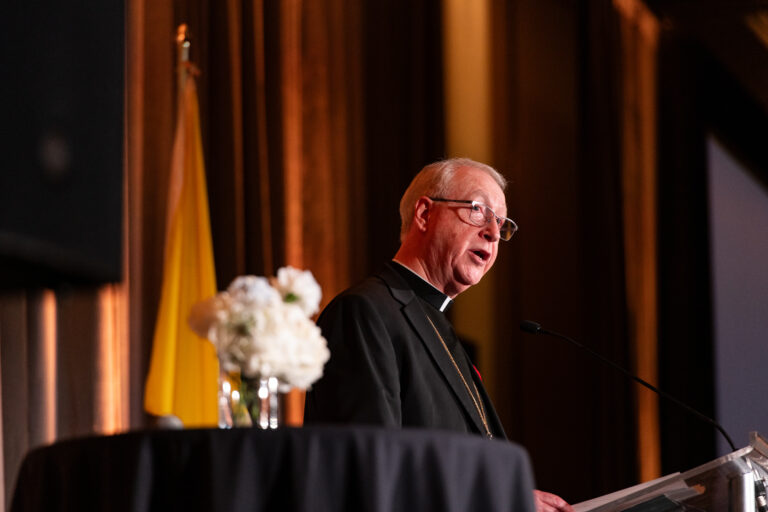


Archbishop Richard Smith is joining Canada’s Catholic bishops are asking Catholics to contact their MPs over proposed federal legislation that would allow people to request euthanasia in advance for a time when they can no longer consent.
Bill C-41, the Medical Assistance in Dying Safeguards Act, would make two significant changes to Canada’s medical assistance in dying, or MAID, law.
It would permanently prevent people from qualifying for MAID when mental illness is their sole underlying medical condition, an exclusion currently set to expire March 17, 2027. At the same time, it would allow advance requests from people diagnosed with serious and incurable illnesses expected to cause an irreversible loss of decision-making capacity.
The Canadian Conference of Catholic Bishops (CCCB) supports keeping the mental-illness exclusion but wants Parliament to remove advance requests from the bill and consider them separately.
“Parliament has a responsibility to examine these questions before considering a change with irreversible consequences for people who can no longer give informed consent,” the CCCB said in a brief to parliamentarians released Nov. 12.
The federal government introduced Bill C-41 on Oct. 27, with Alzheimer’s disease given as one example of an illness that could qualify someone to make an advance request.
A person would make the request while still capable of giving informed consent and describe the circumstances in which they would want MAID after losing that capacity. A doctor or nurse practitioner could later act on the request if the requirements of the law were met.
Advance requests would only be available in provinces and territories that establish their own legislative systems for them. A person would also have to meet MAID eligibility requirements and be experiencing “enduring and intolerable suffering” when MAID was provided.
The bishops say the central problem is that the person receiving MAID would no longer be capable of reconsidering the decision in light of their actual circumstances.
Someone may fear in advance that dementia, memory loss or dependence will make life unbearable, the CCCB says, but people do not necessarily experience those conditions as they once imagined they would.
“An earlier request is not the same as informed consent at the time euthanasia takes place,” the bishops say in a fact sheet released with their brief.
There are also questions about how a person’s wishes would be interpreted after capacity is lost.
Bill C-41 would prohibit MAID if a person demonstrated refusal or resistance. Doctors and nurse practitioners could therefore have to interpret words, sounds, gestures or other behaviour from someone unable to clearly explain what they want.
Families and caregivers may also be asked to help determine whether the circumstances described years earlier have been reached.
The bishops are raising broader concerns about the conditions in which decisions about MAID are made.
People facing serious illness may also be dealing with isolation, inadequate housing, a lack of home or community support, or concern that they are becoming a burden on those caring for them.
The CCCB points to Health Canada data showing that among MAID recipients in 2024 whose natural deaths were not reasonably foreseeable, practitioners identified perceived burden on family, friends or caregivers as a source of suffering in 50.3 per cent of cases. Isolation or loneliness was reported in 44.7 per cent.
The bishops say the response should include better access to geriatric care, appropriate housing, help at home, caregiver respite and palliative care.
“No one should be made to feel that dependence makes them a burden or their life less worthy of protection,” the CCCB says.
The Church’s objection goes beyond whether sufficient safeguards can be added to advance requests. Catholic teaching holds that deliberately ending a person’s life through euthanasia is morally unacceptable.
The bishops argue that allowing the procedure after someone has lost decision-making capacity adds further concerns that safeguards cannot resolve.
They are also questioning why advance requests are being dealt with in the same bill as mental illness.
Canada legalized MAID in 2016 following the Supreme Court of Canada’s Carter decision and expanded eligibility in 2021. The proposed expansion to people with mental illness as their sole underlying medical condition has since been delayed several times and subjected to extensive parliamentary and expert review.
A joint parliamentary committee recommended this year that the exclusion remain in place indefinitely.
The bishops say advance requests have not received the same sustained federal scrutiny and there is no comparable deadline requiring Parliament to enact them now. They want MPs to separate the measures, make the mental-illness exclusion permanent and consider advance requests on their own.
Bill C-41 is currently at second reading in the House of Commons.
Catholics asked to write their MPs now
The CCCB has launched a letter-writing campaign so Catholics can make their views known while the legislation is before Parliament.
A sample letter is already prepared for anyone to copy, personalize with their name and concerns, and send directly to their Member of Parliament.
The letter asks MPs to separate the two measures in Bill C-41, maintain the exclusion for mental illness as the sole underlying medical condition, and oppose advance requests for euthanasia.
The CCCB has also released a parish fact sheet explaining Bill C-41 and is encouraging Catholics to share it, pray for people who are ill and those who care for them, and support people who are sick or frail in their own communities.